 Braille
 iPhone prototype on TestFlight
Listen to a scientific paper. Interrupt it with any question.
Braille reads papers aloud for a retired nuclear cardiologist who is losing his sight. Ask it something and it answers with the paper’s own sentences, then picks up the sentence you left.
From the paper, read word for word
About this paper
- This paper is synthetic. Its authors and findings are invented for testing.
- This web preview does not save a reading position. The app saves the paper and the sentence.
It’s reading now, silently. Sound plays Braille’s own voice.
Interrupt it
A synthetic paper from Braille’s test suite, read by George, Braille’s ElevenLabs voice. The words light up as they’re spoken, above and in braille below.
The same loop in the real app
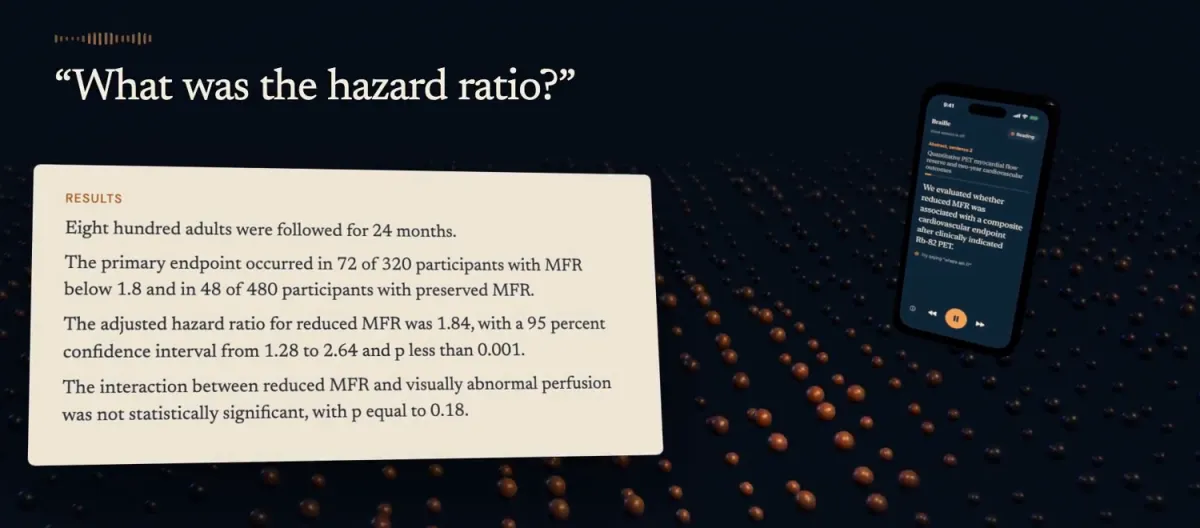
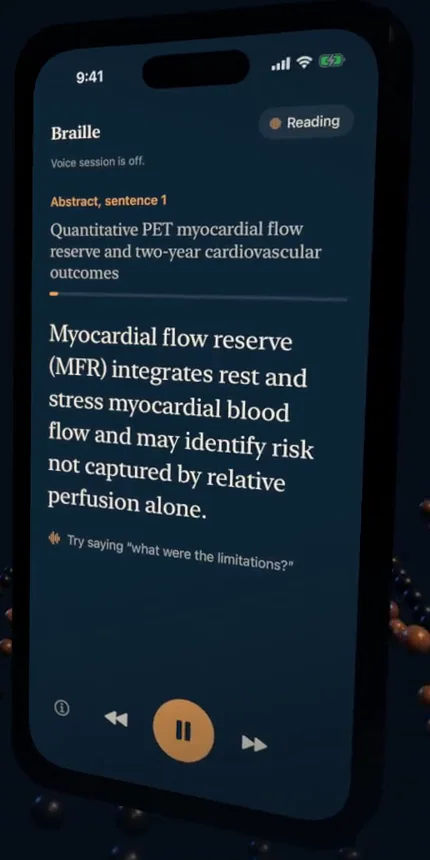
A 38-second film. Braille reads a paper to him on his iPhone, one sentence at a time. Someone asks “What was the hazard ratio?” and the answer comes from the paper’s own sentences. Then “what’s new in my journals?”, “who cited this?” and “get the full text”.
The voice does the work. The buttons are a fallback.
The dock covers reading. Everything else in Braille is spoken.
Read
- keep reading
- go to results
- repeat the numbers
Your place is saved. Reopen the app and the paper waits at that sentence. After an interruption it repeats a sentence rather than skip one you didn’t hear.
Ask
- what was the hazard ratio?
- who funded this?
It reads up to three sentences from the paper, word for word, each labelled by section. If the paper has no answer, it says so.
Keep up
- what’s new in my journals
- where does the paper mention flow reserve?
Follow journals and hear what’s new. Hear where a term comes up, section by section. Compare two papers, each read under its own title and never merged.
Follow citations
- who cited this?
- open reference 12
Hear who cited a paper and open a reference by its number. “Go back to the previous paper” picks it up at the same sentence.
Tables
- read table 2
- the MVD row
Each value is read with its column’s label, and row or column lookups come straight from the table, with no model in between.
Say it your way
- faster
- go to the end
Exact phrases act at once. Anything longer goes to a router that picks a known command or hears a question about the paper. Reading speed runs from 0.75 to 2 times.
Decisions you just used
Braille is for someone with low vision who listens first and looks second. Each of these is in the reader at the top of the page.
The status is a word, not only a color
The pill reads Listening, Reading, Checking the paper or Paused, and VoiceOver hears “Status” and that word. The dot breathes while Braille works and goes still and grey when it pauses.
Your place is held while you hear an answer
The answer tray stops below the position line, so “Paused at” stays in view. Keep reading, and the interrupted sentence starts again from its first word.
The sentence grows, the dock doesn’t
The sentence is the only large thing on screen, set in a serif. In the app every size follows Dynamic Type. At the largest sizes the dock stops growing, and holding a dock button shows a magnified label instead.
Source and saved place wait in a tray
Where the paper came from, and whether your place is saved, sit behind the details button at the left of the dock. The main screen keeps to the paper.
Four colors, from the app icon
The icon is a braille “b” beside sound waves. The reader on this page uses the same four colors.
- Ink#0F2638
- Ink raised#173347
- Ivory#F7EDDB
- Amber#F2A659
Every answer is the paper’s own words
Braille has no server and no accounts. A model only points at sentences, so none of an answer’s wording is the model’s.
You ask
“What was the hazard ratio?”
A model picks
19Sentence numbers and nothing else. On an iPhone with Apple Intelligence this runs on the phone.Braille reads sentence 19
The adjusted hazard ratio for reduced MFR was 1.84, with a 95 percent confidence interval from 1.28 to 2.64 and p less than 0.001.
Stays on the phone
Outside iCloud backup.
- Your voiceApple’s on-device speech recognition hears commands. Audio is never recorded or sent.
- Your readingThe open paper, your place and the journals you follow.
- Your API keysIn the phone’s Keychain, not synced, deleted when you remove them.
Leaves only when it has to
Straight from the phone. There’s no Braille server in between.
- PubMedSearch words, journal names and paper identifiers.
- OpenAlexWhen a paper opens with only its abstract, its DOI, to ask whether a legal free copy exists.
- OpenAI or ElevenLabs, on your own keyThe text Braille speaks, for the natural voice. With OpenAI, also your recognized words and the paper’s text, to route a request or answer a question. Without a key, Apple’s voice reads on the phone.
- A publisher’s site, if you open oneAnything you type there, including a sign-in, goes to the publisher. Braille never tries to get past a bot check.